
Some days at the makerspace, nobody sets out to invent anything.
We shared a reel from One Punggol in June 2025 with three devices in it — and none of the three started life as the thing it ended up being. One was somebody else’s design, remixed. One was a volunteer’s answer to a leak his mum kept dealing with. And one was two ordinary things put together — a grip made for a hand that can’t hold a pen, and a clip made for a broom handle. Put together, they are the pattern most of our assistive making follows: borrow a design, adapt it to a real person, share the file so the next person can do the same.
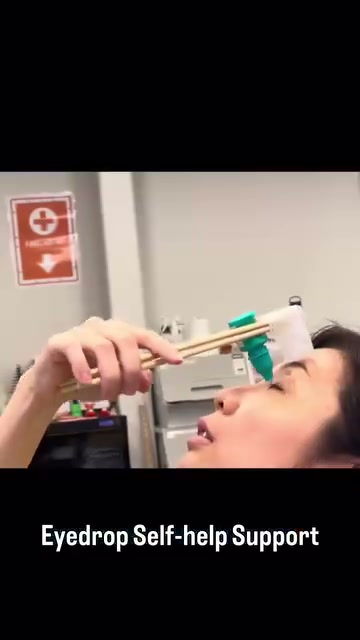
First, the eyedrops. Putting drops in your own eyes with unsteady hands is a fiddly, anxious little job: hold your head back, hold the bottle steady, aim, squeeze — and hope the drop lands in the eye and not on your cheek. The Eyedrop Self-help Support is a small printed clip with slots for two pairs of chopsticks. Slide the chopsticks in, rest the bottle between them, and rest the end of the device on your forehead. Your forehead does the aiming, so your hands only have to squeeze. The original design came from SONOKO; Saad remixed it in Tinkercad, rounding the corners and edges, and printed it in flexible TPU so it gives a little against the skin.
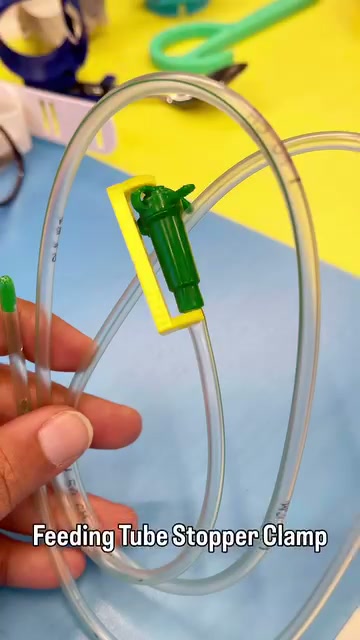
Second, the feeding tube. Francis designed a clamp for his mum, to stop leakage from the spigot of her naso-gastric feeding tube — the little tap at the end of the tube that feeds her. The usual answer is medical tape; the clamp is the maker’s alternative, a small printed clip that pinches the tube shut instead. It comes in yellow and green in the reel, and a blue one too. The Printables page is plain about what it is and what it still needs: “Francis designed this for his mom. Feedback from nurses and other caregivers invited.” It is titled ANGIE on Printables — and the invitation is still open.
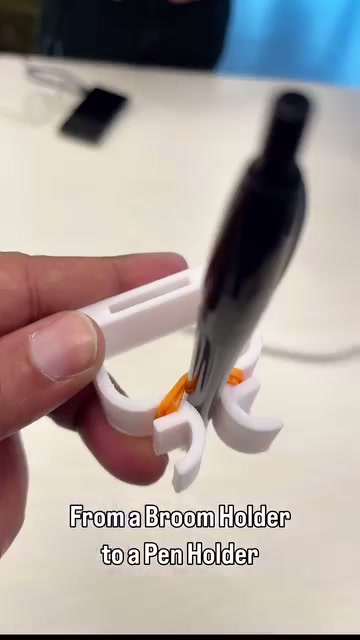
Third, the pen. The purple printed device is DRAG, by PrintLab — designed for exactly this: helping a user with limited fine motor control hold and use a pen. You write or draw without forming a tight closed grip with your fingers: rest your hand on the ergonomic mouse-shaped body, press, and drag. It suits people with arthritis or other hand mobility issues that make writing or drawing painful. And the broom holder is a low-cost household clip — the kind meant to hold broom handles to a wall or door. Put the two together and you have a reliable, affordable way to hold a handle, without having to redesign a 3D-printable mechanism at all. The words on screen say it plainly: “From a Broom Holder to a Pen Holder.” Nothing was redesigned for the job. Two things that already existed were simply put together — and together they hold a pen steady for a hand that needs one.
That is the whole post, really. No single device here needed inventing from zero. The eyedrop support needed a remix and softer corners. The tube clamp needed someone who knew the leak first-hand. The pen holder needed two things that already existed — a grip made for a hand that can’t hold a pen, and a clip made for a broom handle — put together instead of redesigned. And the reel ends where our sessions usually end: a little Prusa Mini printing pink parts in the background, and the words “Let’s build better together.”
So if you have a small daily task that keeps going wrong — drops that miss, a tube that leaks, a pen that will not stay put — bring the thing that almost works. We will look at it together, and very likely the answer is already on the table — sometimes two ordinary things, put together.
What a maker can do
- Print the eyedrop support, in something flexible. Eyedrop Selfhelp Support on Printables, by Saad Caffeine — a remix of SONOKO’s original, redesigned in Tinkercad with rounded corners and edges, printed in TPU / FLEX. You will need two pairs of chopsticks to slot into it, and the eyedrop bottle itself. Rest the end on your forehead and let your forehead do the aiming.
- Print the feeding-tube clamp — and talk to a nurse first. ANGIE: Feeding Tube Stopper Clamp by Francis on Printables, by Saad Caffeine, designed by Francis for his mum. It stops leakage from the spigot of a naso-gastric feeding tube, as an alternative to medical tape. The page asks for feedback from nurses and other caregivers — if you print one, that feedback is part of the making, not an afterthought.
- Combine a printed grip with a household clip. The pen holder in the reel is two things, not one: DRAG | Assistive Writing and Drawing Device on Printables, by PrintLab — a purple printed device made to help a hand with limited fine motor control hold a pen — and a low-cost household clip made to hold broom handles to a wall or door. Put together, they hold a handle reliably and affordably — no redesigned mechanism needed. DRAG comes with a maker guide and step-by-step assembly instructions, so it is easy to make and use. That is the invitation in this post: before you design a new mechanism, look for a household clip that already does the holding.
- Borrow, adapt, share — in that order. All three devices in this post follow the same loop: start from a design that already exists, change it for one real person, and put the changed file where the next person can find it. You do not have to invent from zero to make something useful.
Sources
- Three hacks — @salvagegardenmakerspace, 3 Jun 2025. The reel shows a purple printed device made to help a user with limited fine motor control hold and use a pen, combined with a low-cost household broom-holder clip, with the on-screen text “From a Broom Holder to a Pen Holder”; an “Eyedrop Self-help Support” — a small printed clip attached to two wooden sticks/chopsticks holding an eyedrop bottle, shown being used by a person to self-administer drops; a “Feeding Tube Stopper Clamp”, a yellow and green clip securing a feeding tube, followed by a blue version; and an Original Prusa Mini printing pink parts, ending with the text “Let’s build better together”.
- DRAG | Assistive Writing and Drawing Device — Printables, by PrintLab. “An assistive device that enables users to write or draw without having to form a tight closed grip with their fingers” — rest your hand on the ergonomic mouse-shaped body, press and drag; suited to people with arthritis or other hand mobility issues, and symmetrical for left- and right-handed users. Released as an open-source concept, with a maker guide and step-by-step assembly instructions in the Files section.
- Eyedrop Selfhelp Support — Printables, by Saad Caffeine. Description: “eye dropper support, assistive device to help with applying eyedrops. Insert two pairs of chopsticks into the slots, place the eyedrops bottle between the chopsticks, rest the end of the device on the forehead, making it easier to position the bottle so the drops fall into the eye as intended.” Original design by SONOKO (Thingiverse); remix with rounded corners and edges, redesigned in Tinkercad. Material noted as TPU / FLEX.
- ANGIE: Feeding Tube Stopper Clamp by Francis — Printables, by Saad Caffeine. “Francis designed this for his mom. Feedback from nurses and other caregivers invited.” Description: “Used to stop leakage from spigot of naso-gastric ‘ng’ feeding tubes”.