
Have you ever stood at your own front door, key in hand, and missed the keyhole?
For most of us it is a half-second fumble. For a person with limited mobility or low vision, it is a fiddly, frustrating moment that happens every time they come home — at the door that is supposed to be the easy one. The key is small, the hole is smaller, and lining the two up by feel takes a steady hand and a clear view. Take either away and getting inside becomes a job in itself.
What if the door helped you find the hole?
That is what HoKey does. It is a small, light-blue, circular printed disc with a black keyhole-shaped cutout in the middle. You hold it over the lock, and the cutout sits where the keyhole is. Then the key slides through the finder and straight into the lock — no hunting, no scratching around the plate, no second attempt. In the reel we shared from the entrance of Punggol Regional Library, a hand wearing a light-blue silicone wristband holds the finder against a white door with a silver lever handle, and a silver key with a red “KEY” tag goes through it and turns. That is the whole demonstration, and it is enough: the finder does the lining up, so the hand only has to push.
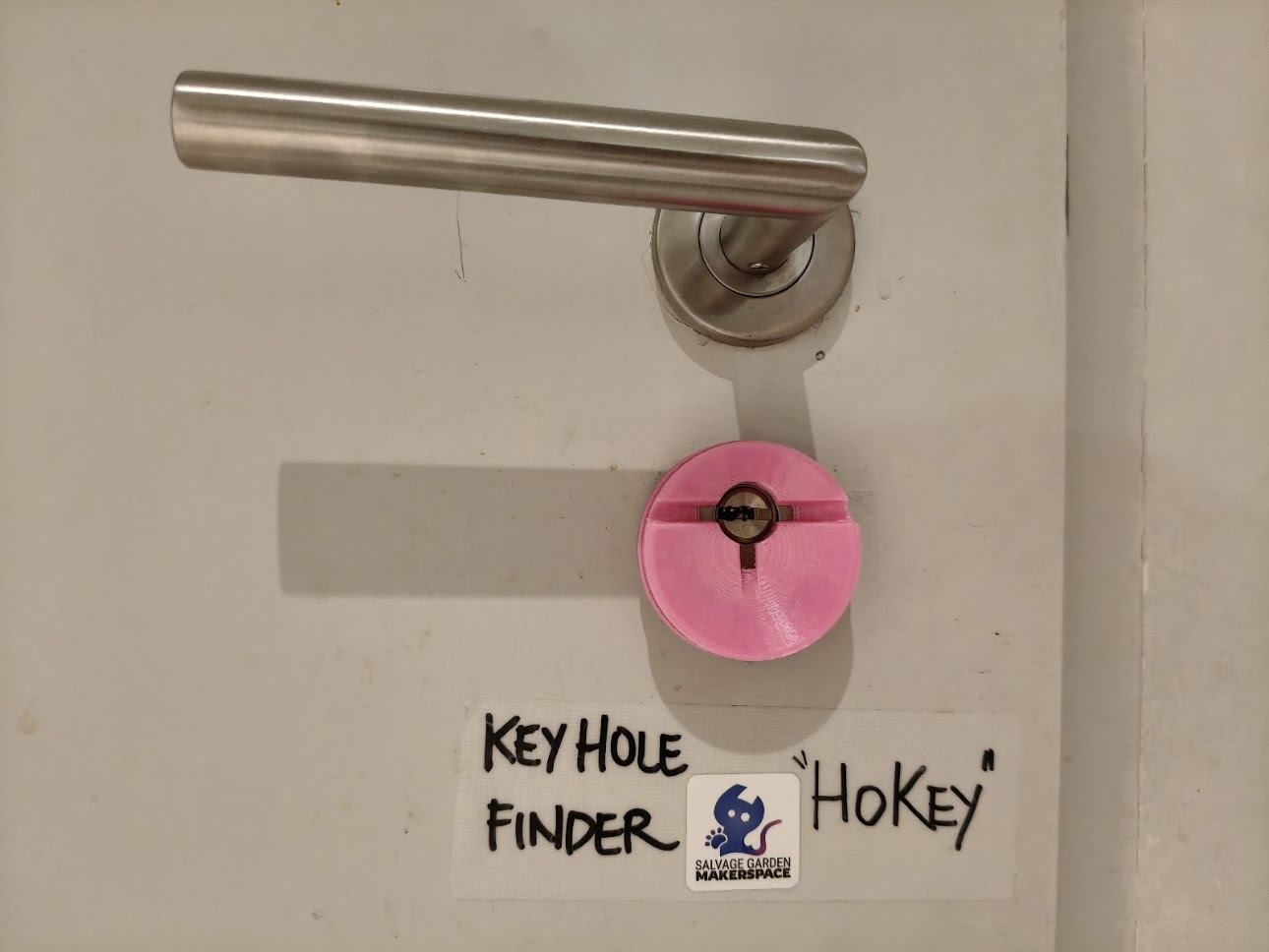
And here is the honest part: this one is not finished. It is a prototype. When someone asked in the comments whether it was for sale, the answer was plain — not yet, it is still being tested. That is not a failure; it is the point of the post. The reel does not end with a shop link. It ends with an invitation: come to the library, try it, and help us make it better.
Because a keyhole finder is only useful if it fits the door in front of you. Locks are not all the same shape, and neither are keyholes, or hands, or the way a person holds a key. The next version has to answer the questions this prototype raises: does one cutout fit every front door, or does each door need its own finder? How big should the disc be for a hand that cannot grip a small thing? Does it stay on the door, or travel on the keyring? Those are not questions a maker can answer alone at a workbench. They are questions for the person standing at the door, key in hand.
So this is the smallest post in the series, about the smallest device — and that is exactly why it belongs here. Not every solution needs a printer farm. Some need a disc, a cutout, and a Sunday afternoon with the people it is for.
If lining up a key is a job you have to think about, come to a Sunday session at Punggol Regional Library and try the prototype. Bring your key, show us your lock, and tell us what does not work yet. We will print the next version together — and the one after that, until the door stops being a puzzle and goes back to being just a door.
What a maker can do
- Print a guide, not a new key. HoKey keyhole finder guide by Saad Caffeine on Printables — a free STL, shared under CC BY-SA 4.0. Link: https://www.printables.com/model/1911966-hokey-keyhole-finder-guide The printed finder sits over the lock and guides the key the person already owns — the key stays familiar, the finder does the lining up. Start from the person’s own key and their own lock, and fit the finder to those, not the other way round.
- Test it on a real door, with the real user. A finder that works on a library door may not fit a home lock. Try it where the person actually lives, in the light they actually come home in, with the hand they actually hold the key in.
- Ask what the next version should change. The prototype is an invitation, not a product: does the cutout need to be bigger, the disc easier to grip, the finder shaped for a different lock? Record what the tester says and print that change, rather than guessing it.
- Keep it small on purpose. This is the one-photo, one-paragraph device in the collection — proof that a maker does not have to invent from zero, or build something big, to make a daily task easier. A small printed disc, fitted well, is enough.
Sources
- Keyhole finder — @salvagegardenmakerspace, 31 Jul 2025. Link: https://www.instagram.com/reel/DMzMtmFxNcG/
- HoKey keyhole finder guide — Printables, designer Saad Caffeine (@SaadCaffeine), updated 13 November 2026, CC BY-SA 4.0, 1 STL file (keyholeguide, 96 kB). Link: https://www.printables.com/model/1911966-hokey-keyhole-finder-guide