
Have you ever tried to hold your hand still in exactly the right position — and realised you do not know what “right” even means?
A hand splint is a small thing that has to get a lot of small things right. It holds the hand in a useful position: wrist straight, fingers free to move, thumb out of the way. Get the angle wrong by a few degrees, or press in the wrong place, and it does not help — it hurts, or it gets taken off and left in a drawer.
That is why the people who fit splints and the people who print them need to be in the same room. And for once, they were.
The session was a full house at a MakeIT Sunday: occupational therapists and SalvageGarden makers learning splints together, hands-on. The makers brought the printers and the plastic. The therapists brought the anatomy — including the joint that decides whether a splint works at all: the MCPJ, the knuckle joint where each finger meets the hand. Say it slowly: metacarpophalangeal joint. It is the hinge the whole hand turns on, and a splint that ignores it is a splint that does not work.
And the making itself is the lesson. A printed splint starts flat: a sheet of plastic, printed, then warmed and molded to the hand — thermoforming, the same technique the hand-orthosis makers use. The plastic does not forgive a bad first fit. But it does let you try again: reheat it, reshape it, try once more. That is the whole difference between a splint you order and wait for, and a splint you make in the room with the person wearing it.
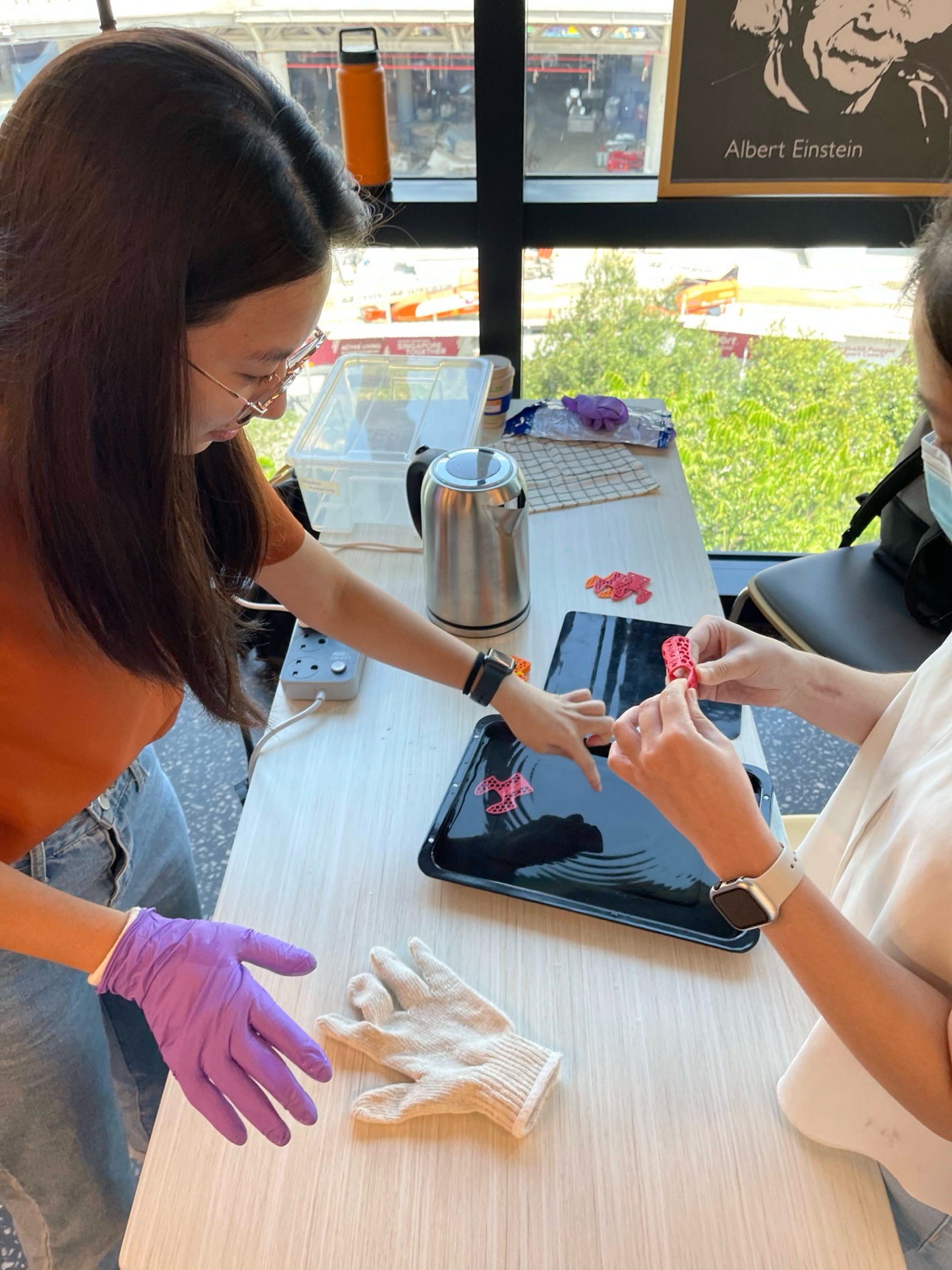
There is a model for exactly this on Printables — a wrist splint that prints flat and molds to the wrist with a little heat. PLA, hot water, a thin layer of fabric wrapped around the wrist first so the heat does not bite, then mold it, hold it until it cools and hardens. If the fit is off, reheat and adjust — a few times, if needed. Velcro channels along the sides hold it in place. Sizing is by scaling in the slicer, a few percent at a time, measuring the wrist and forearm where the splint will sit. The model page says it plainly, too: the designer is not a medical professional, and the splint is not a substitute for professional advice. That honesty is part of the design.
That is what a maker can do that a catalogue cannot: sit at the same table as the therapist, learn the name of the joint, and fit the device with the person — then change it, in the room, when the first try is not right.
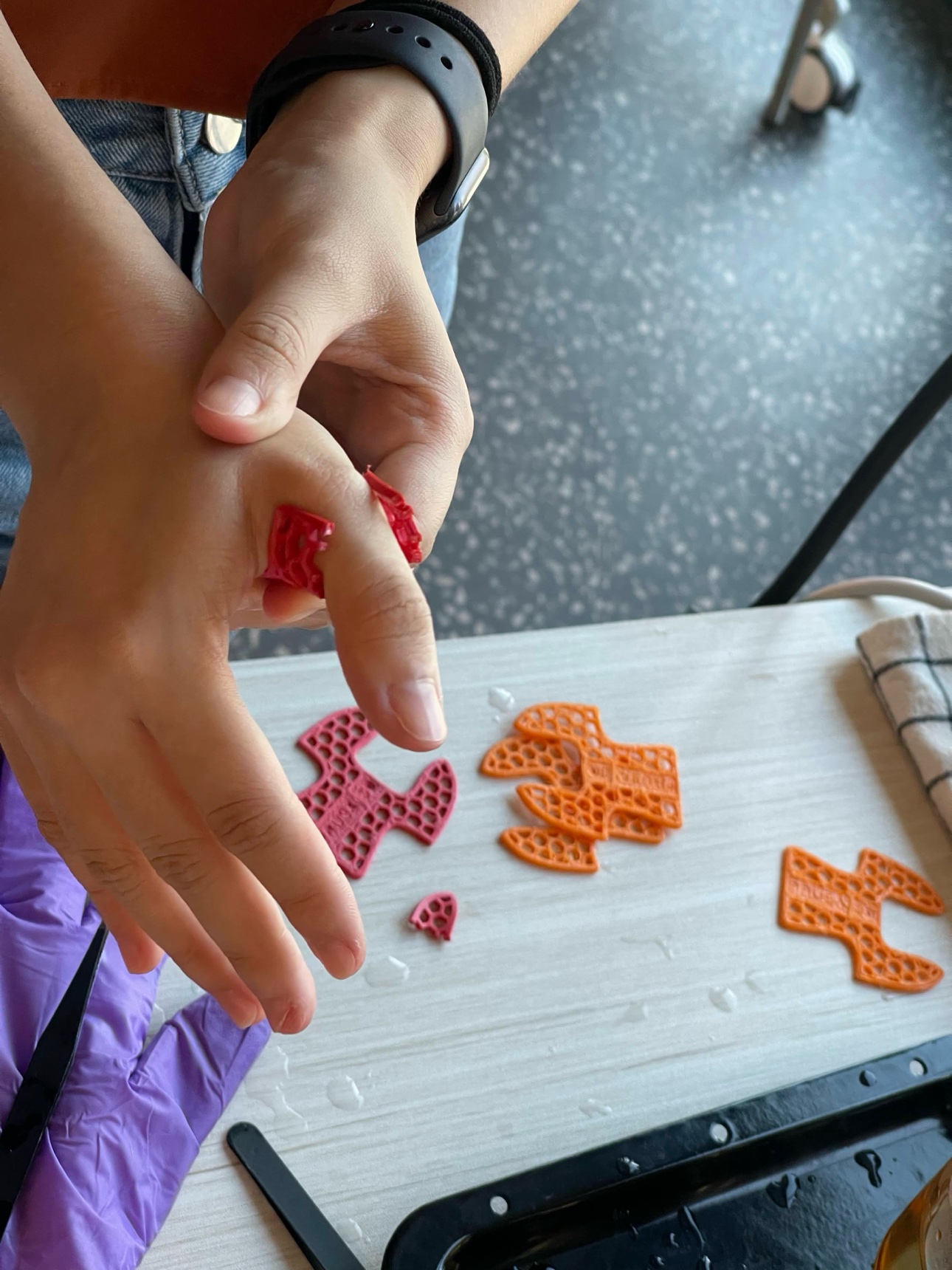
There is a companion to this story in the series: the hand orthosis, built for stroke survivors relearning fine motor skills, also thermoformed, also fitted by heating and shaping. The splint session is where makers learn the language for it. The orthosis is where that language turns into a device.
So if you have ever wondered what makers and therapists could teach each other — the answer is: a joint name, a warm sheet of plastic, and a splint that fits because the right people were in the room together.
What a maker can do
- Print one — and fit it with a therapist in the room. Wrist Splint (Custom Moldable) by JordanBurghoff on Printables: prints flat in PLA, molds to the wrist with hot water, shared under a CC BY-NC-SA licence. Bring an occupational therapist into the fitting — the joint names matter as much as the print settings. Link: https://www.printables.com/model/1238124-wrist-splint-custom-moldable
- Learn the joint names. The MCPJ — the knuckle joint where each finger meets the hand — is the hinge a hand splint has to respect. Ask a therapist to show you on your own hand before you print.
- Go further with the hand orthosis. Improving fine motor skills, designing a 3D FDM printed orthosis by Piotrownik on Printables: a hand orthosis for stroke survivors relearning fine motor skills — eight components, elastic and Velcro, molded to fit by heating — shared under a CC BY-NC-SA licence. It is the deeper dive from the same thermoforming idea. Link: https://www.printables.com/model/870468-improving-fine-motor-skills-designing-a-3d-fdm-pri
Sources
- OT splint session — @salvagegardenmakerspace, 29 Oct 2023 (story highlight). Link: https://www.instagram.com/stories/highlights/18034657036554931/?story_media_id=3224762713721403823
- Wrist Splint (Custom Moldable) — Printables, designer JordanBurghoff (@JordyBurghoff_167038), updated 22 March 2025, CC BY-NC-SA 4.0. Link: https://www.printables.com/model/1238124-wrist-splint-custom-moldable
- Improving fine motor skills, designing a 3D FDM printed orthosis to assist in the rehabilitation of individuals with hand spasticity — Printables, designer Piotrownik (@Piotrownik_2053105), updated 26 September 2024, CC BY-NC-SA 4.0. Link: https://www.printables.com/model/870468-improving-fine-motor-skills-designing-a-3d-fdm-pri