
Picture family game night. Everyone crowds round the table, the pieces rattle, someone shouts out a word they have spotted — and one player is sitting it out.
Not because they do not want to play. Because the game was never made for them to play. Most board games are visual first: look at the board, read the letters, spot the pattern. A blind or low-vision player is left out, or given a lesser role — the helper, the scorekeeper, the one who waits.
What if the game came to the player instead, in a language their fingers already know?
That is what SalvageGarden’s tactile games do. They take games everyone already knows — Connect Four, tic-tac-toe, Sudoku, memory, Boggle, Scrabble, chess — and rebuild the board so it can be read by touch. No new rules to learn, no special version to sit apart with. The same game, the same table, everyone playing together.
It starts with the board. M4TCH is Connect Four, rebuilt as chunky textured cubes — big enough to grip with limited fine motor control, each piece with its own texture so a player can tell the rows and columns apart by feel. Twenty-one white cubes, twenty-one green textured ones, and the same cubes play T3, tic-tac-toe. The first prototype was tested against colour-blindness too, with a simulator app, because being able to feel the pieces is only half the game — being able to tell them apart matters as well. And the board keeps growing: SuperT3 plays nine games of tic-tac-toe at once, and P5 asks for five in a row.
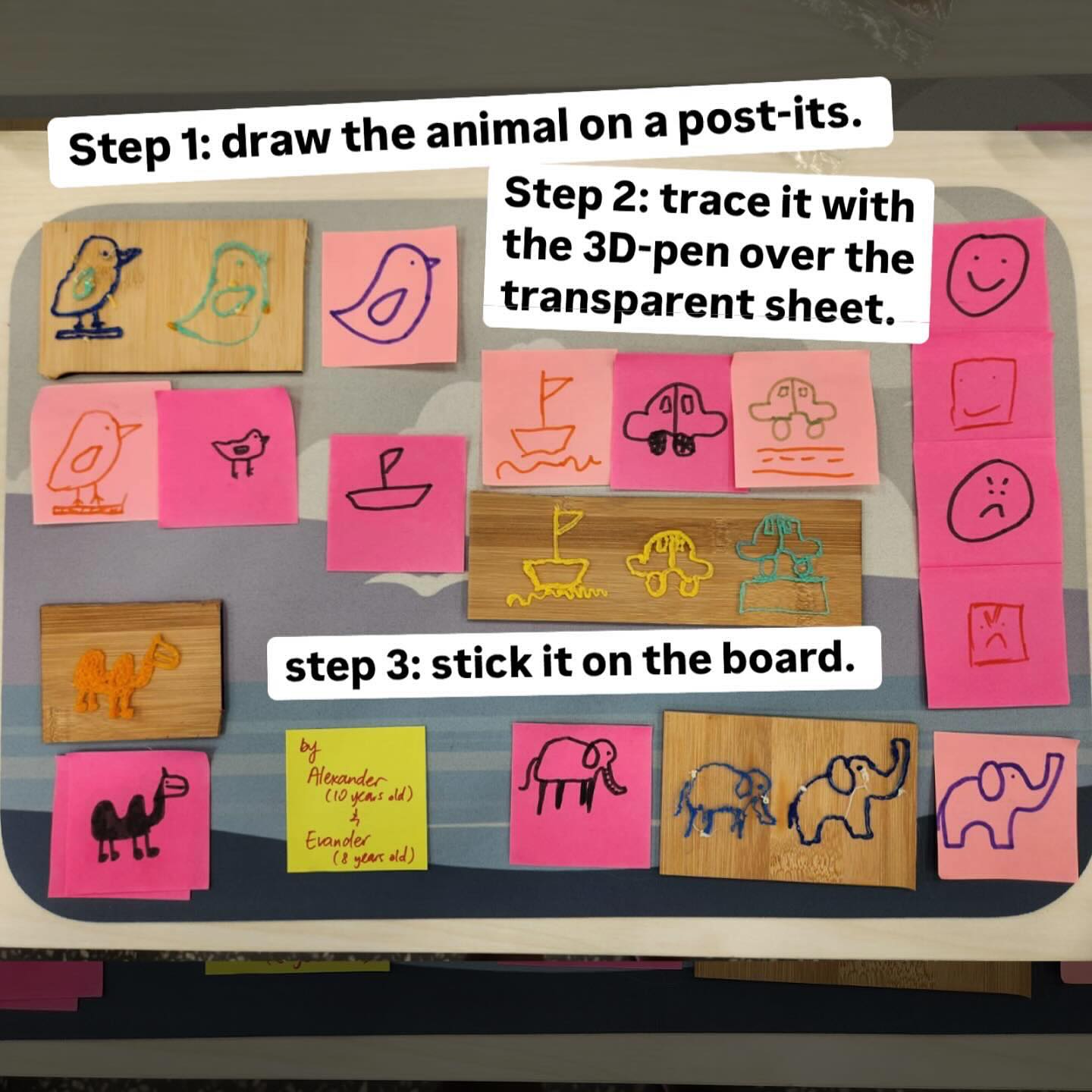
Then there is the memory game with the youngest designers in the room. Touché started as animals drawn on post-it notes by Alexander, ten, and Evander, eight — a bird, a boat, a car, a camel, an elephant — traced with a 3D pen and turned into tactile cards. Flip two, feel the shapes, find the pair. Two children drew a game, and now it works for players who cannot see the cards at all.
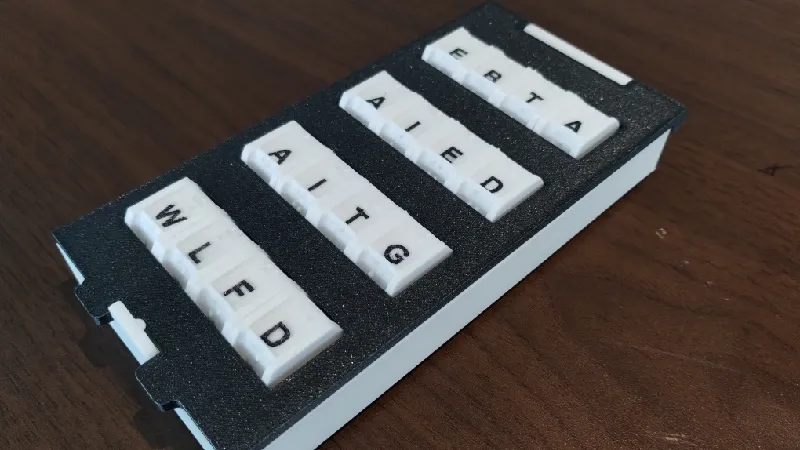
Numbers work the same way. A tactile Sudoku uses raised shapes instead of printed digits, and Ruri’s Shape Sudoku swaps the numbers for distinct shapes a ten-year-old co-designer could tell apart by touch, with the board’s centre raised so a player can find it without looking. Words, too: Braille Boggle spins hexagonal dice with braille and print letters, then locks them in place so the game can be passed around the table; Braille Scrabble is a board in four quarters, its bonus squares marked with shapes instead of colours, its tiles readable by touch as well as by sight.
And the games keep coming, because the test is so simple. In September 2026, at a Friday session at Enabling Village, volunteers played tic-tac-toe blindfolded — and the tokens kept getting knocked out of place. So they added magnets, modelled new tokens, printed them, and tested the game again. That is the whole method in one afternoon: play it with your eyes closed, find what fails, fix that, play it again.
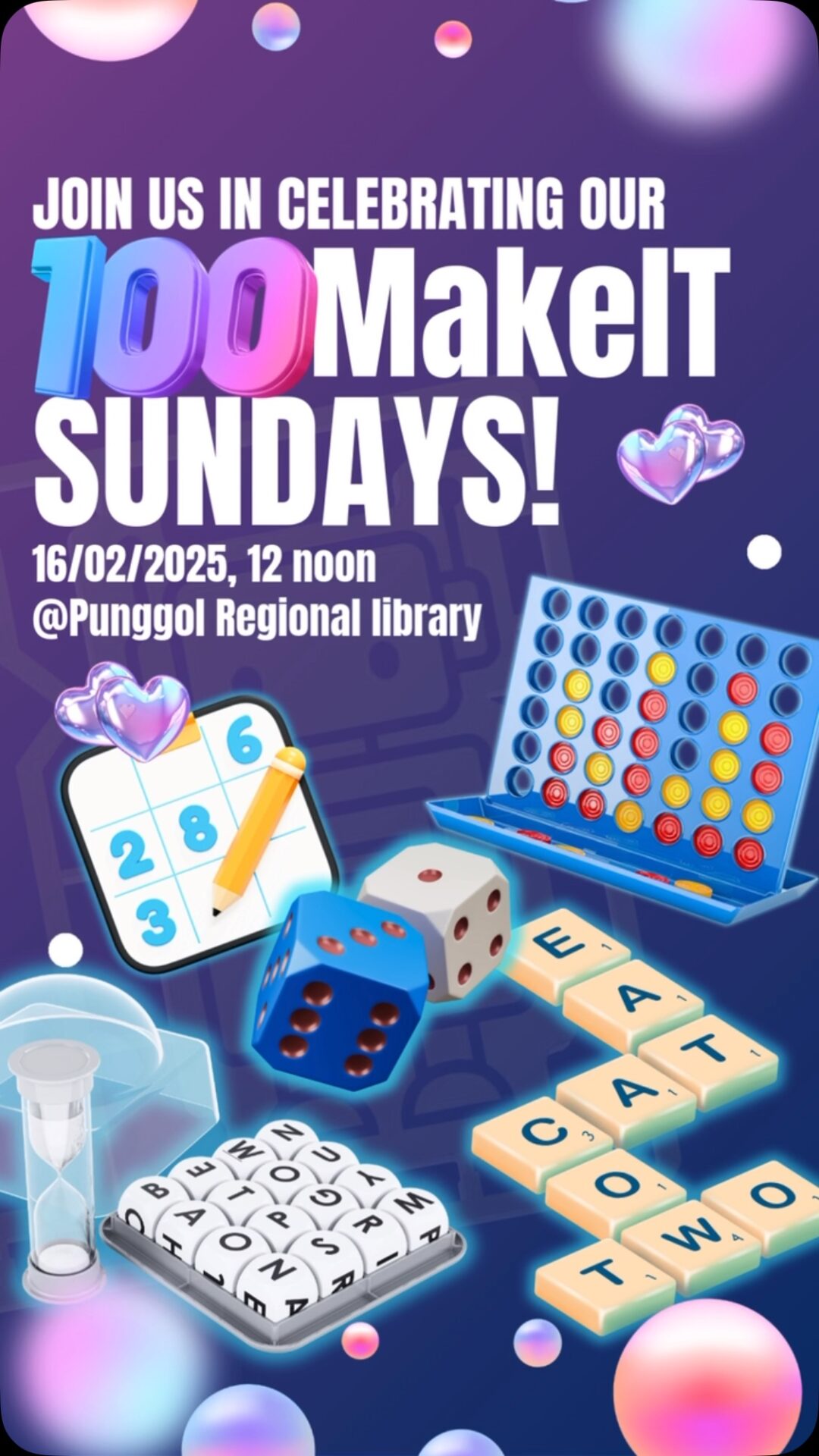
That is also why these games get played in public, not just at the library table. SalvageGarden took them to PlayPlayFair, Singapore’s board-game fair for local designers, in June 2023 and again in 2024 — a booth where anyone walking past could sit down and play, and where the first customer picked up M4TCH and played it on the spot. In February 2025, the hundredth MakeIT Sunday was marked with a game day at Punggol: Scrabble, Boggle and Sudoku next to the co-created T3, Match4, P5 and SuperT3, with 3D-printed word tiles ready — and an open invitation to try Scrabble blindfolded.
The same instinct showed up somewhere unexpected in October 2026. A four-student SalvageGarden team at Singtel’s inclusive hackathon built an odd-one-out game where the game master decides which senses each round uses — sight, hearing, touch. As one of the team, John Ong, put it: the different dimensions let people with different sensory abilities play, “such as turning on the sound and tactile dimensions for a blind player.” Turn a sense off, and the game does not break. Turn another on, and a player who was locked out is back in. That is empathy you can feel in your hands, not a lecture about it.
So this is the series. One game at a time, over the next few weeks: the Connect Four family, the memory game the children drew, the Sudoku boards, the word games, the chess sets, and the newest ones still being tested. Each one is a familiar game, made touchable, played together — and each one started the same way, with someone at the table asking who could not play yet, and what the board was getting wrong.
Come to a Sunday session and try one with your eyes closed. Bring a game you love, and we will work out, with you, how to make it playable for everyone at the table.
What a maker can do
- Start with a game everyone already knows. Nobody has to learn new rules — the work is all in the board. Pick the game your family already plays, and make that one touchable.
- Test it with your eyes closed. That is the whole user test. If you cannot play it blindfolded, a blind player cannot play it either — and the fix is usually small: a texture, a magnet, a raised edge.
- Let children design. The memory game was drawn by a ten-year-old and an eight-year-old; the shape Sudoku was co-created with a ten-year-old. A child who notices who is left out is already doing inclusive design.
- Take it to a public table. A game fair, a library, a carnival — strangers will find the flaws faster than any checklist, and they will do it by playing, which is the point.
- Print one — and play it together. The files for most of these games are free on Printables (see Sources). Print a set, sit down with a blind or low-vision player, and let “is it fun?” decide what needs changing next.
Sources
- M4TCH at PlayPlayFair — https://www.instagram.com/p/Ct51xPvSpu6/
- 100 MakeIT Sundays game day — https://www.instagram.com/reel/DF7ik9ev2GB/
- Touché memory game — https://www.instagram.com/p/DByeDprPzsm/
- Games you can play with your eyes closed — https://www.instagram.com/p/C0YUcZ1ORUa/
- Braille Boggle — https://www.instagram.com/reel/DHlLwRgvLtV/
- Magnetic Tic-Tac-Toe — https://www.instagram.com/reel/Dc414MHu3nD/
- Project: Match-4 and TicTacToe T3 Tabletop Inclusive Game — https://salvage.garden/project-match-4-and-tictactoe-t3-tabletop-inclusive-game/
- SuperT3 — https://salvage.garden/what-we-do/tactile-games-supert3/
- P5 — https://salvage.garden/what-we-do/tactile-games-p5/
- Inclusive Games Collection — https://salvage.garden/make-inclusive-tech-sundays/
- Printables models: Match-4 1382319 ; Tactile Tic-Tac-Toe 616588 ; Touche: tactile memory game 991868 ; Touche: Tactile Shapes Memory Card Game 1299774 ; Tactile Sudoku 4×4 992733 ; Ruri’s Shape Sudoku 1334895 ; Braille Boggle 1002930 ; Braille Scrabble 493793
- Braille Boggle — Make:able Challenge — https://www.makeablechallenge.com/toolkit/get-inspired/ and Bullis School — https://www.bullis.org/news/article/~board/bullis/post/making-for-social-good-boggle
- Singtel hackathon spotlights inclusive games — https://www.businesstimes.com.sg/lifestyle/singtel-hackathon-spots-inclusive-carnival-games-children-disabilities
- PlayPlayFair — https://www.origame.co/play-play-fair