
What does a hand cost?
If it is prescribed, fitted in a clinic and built for one person, it can cost more than a car. If it is printed by volunteers, fitted at a library table with the wearer sitting right there, it can cost about £30 in materials — that is Team UnLimbited’s figure for their open-source arm, and the files are free.
That is the gap SalvageGarden has been working in since 2023: not a cheaper copy of a clinical prosthesis, but a different thing altogether. A hand the wearer helps design, printed in the open, fitted by hand — literally — and fixed by the same community when it breaks.
It starts, as always, with the person, not the printer. A person with an upper-limb difference wants a hand that fits their body, their life and their budget — not a device prescribed to them. The open-source designs come from e-NABLE, a global network of volunteers who share free 3D-printed mechanical hands, and from Team UnLimbited in the UK, whose arms are the first fully parametric, thermo-formed 3D-printed limbs: you enter three measurements — hand length, forearm length, bicep circumference — and the files come back scaled to fit that one person.
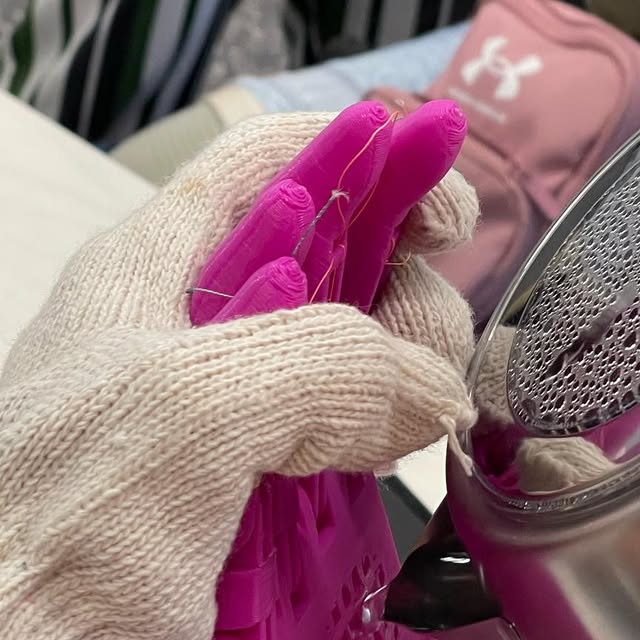
Thermoforming is the part that makes it real. The printed parts come off the printer flat and stiff; heated, they soften just enough to be shaped around the wearer’s own arm, then they hold that shape. In September 2023 the volunteers were doing exactly that at a MakeIT Sunday — a gloved hand holding bright pink printed fingers under the heat, shaping them to fit. A month earlier, in August 2023, they had built their first above-wrist prototype, with the wearer an active participant in the prototyping — measuring, trying, telling the makers what worked. The photo from that session is still the clearest picture of the idea: a full printed hand and forearm gauntlet on a cutting mat, unpainted, unglamorous, made to measure.
And then the part nobody puts on a poster, but everybody who has ever owned a printed hand knows: it breaks. Or a wire comes loose, or a finger stops closing. A printed hand needs repair, and a community that can fix it is as important as one that can print it.
That is what happened on Repair Day, 18 October 2026. At a Make Inclusive Tech (Repair Day Special) session at One Punggol, volunteers and a young participant sat down with a 3D-printed Iron Man-style prosthetic hand — golden palm, red fingers — and fixed it: threading wires, tightening screws with small screwdrivers, holding the finished hand up for the camera. The reel ends with a collage of Polaroid-style photos and one word overlaid: FIXED!
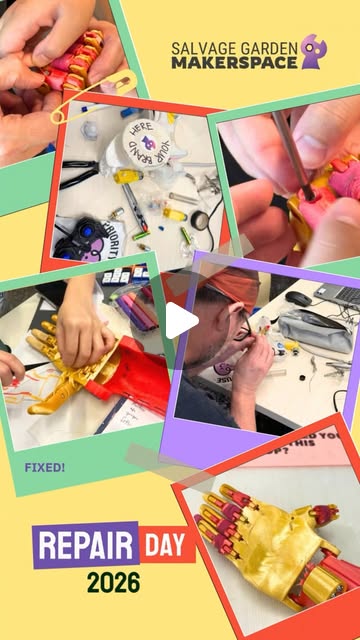
Three years after the first prototype, the story had come full circle — from printing a hand for someone, to teaching someone to repair one. That is the whole point. A hand you can print is good. A hand you can fix, together, at a library table, is better — because it stays working, and the person who wears it knows the people who can keep it that way.
One honest line, because it matters with a device like this: these are community-made assistive devices, not clinical prosthetics. They do not replace a medical device, and the fitting happens with the wearer in the room — never instead of clinical care. What the community offers is different: a hand shaped around one person, made openly, repairable by the people who made it.
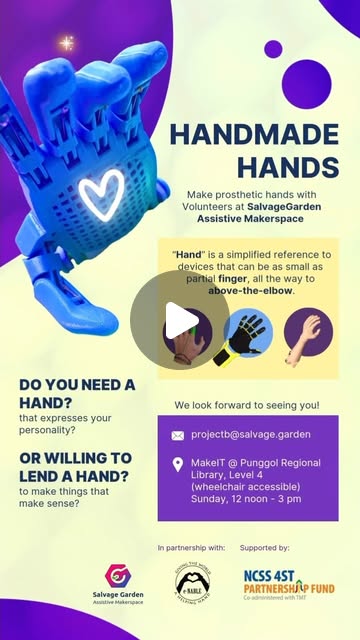
So — do you need a hand? Or are you willing to lend a hand? In October 2024 the volunteers took that question to lyf Sustainival, with a pop-up booth called HANDMADE HANDS, inviting anyone to come and help create 3D-printed prosthetic hands — from partial fingers all the way to above-the-elbow. The invitation still stands. Come to a Sunday session, bring your printer or just your hands, and help make one. Or bring someone who needs one, and help design it with them.
What a maker can do
- Start from the open designs, don’t start from zero. The UnLimbited Phoenix Hand (wrist-powered, for a wearer with a functional wrist and palm) and the UnLimbited Arm (elbow-powered, for a wearer with a functional elbow) are free and open source, with files that scale to the wearer’s measurements. Pick the design that matches what the wearer can move. The Phoenix Hand is also mirrored on Printables as model 129817, a community re-upload of the E-NABLE files.
- Thermoform the fit, don’t guess it. Print the gauntlet, heat it, shape it around the wearer’s arm while they are there. The fitting is the making — three measurements in, one hand out, adjusted on the spot.
- Plan for the repair, not just the build. Print spare fingers, keep the screws and wire to hand, and teach the wearer — and a young volunteer — how to fix it. A hand that can be repaired at a library table stays a hand.
- Let the wearer design it. Colour, grip, size, style — the Iron Man hand got fixed because a young participant cared enough to fix it. Ask what they want it to look like, not just what it should do.
Sources
- First above-wrist prototype — SalvageGarden Instagram post, 27 Aug 2023
- Thermoforming a prosthetic hand — SalvageGarden Instagram post, 10 Sep 2023
- Prosthetic hands at lyf Sustainival — SalvageGarden Instagram reel, 21 Oct 2024
- Iron Man hand repaired — SalvageGarden Instagram reel, 23 Oct 2026
- Files: UnLimbited Phoenix Hand — NIH 3D entry 3DPX-020258 and Thingiverse thing:1453190; also mirrored on Printables as model 129817, a community re-upload of the E-NABLE files (via Thingiverse thing:1674320). UnLimbited Arm v2.0 (Alfie Edition) — Thingiverse thing:1672381. No Printables model covers the UnLimbited Arm.
- Team UnLimbited — About and e-NABLE Italia FAQ