
Imagine picking up a spoon — and having to twist your whole arm just to keep the food on it.
For a person with an upper-limb difference, that is what an ordinary spoon asks for, three times a day. The spoon is fixed, the arm is not, so the arm does the twisting. Food slides off. Soup spills. Eating becomes a careful, tiring job instead of an ordinary one.
What if the spoon bent instead?
The adjustable spoon does exactly that — or rather, the holder it sits in does. It is a simplified, 3D-printed utensil holder: a small printed piece that holds an ordinary spoon, with its length and its direction customisable to the person using it. Set the angle right and the spoon scoops level, the food stays put, and the arm stays comfortable. No twist, no spill, no asking for help.
We first shared it in a reel from One Punggol, in July 2025. The woman in it is wearing braces on her wrists, and she lifts a coffee cup with the spoon — a small, everyday moment, done with barely any wrist rotation at all. Around her on the table are the signs of how the device got there: a blue sticky note covered in hand-drawn sketches of spoon angles, rubber bands, a marker, a pen, and a 3D printer humming in the background. A collaborator beside her is holding a white printed piece, guiding it into a blue ring — the white-and-purple piece that forms the core of the holder.
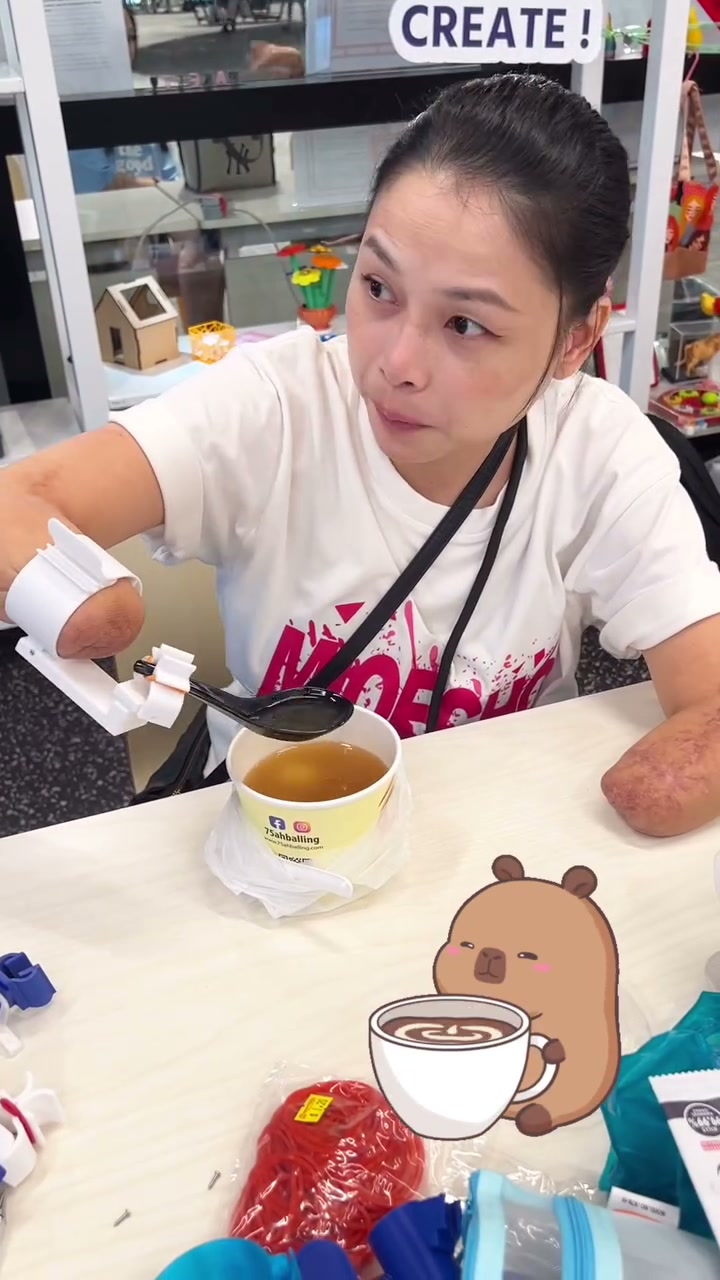
That table is the whole story, really. The first idea was not this simple. The work was in simplifying it: how the spoon is held, how it is installed, how little the holder needs to be to do the job. Length, then angle, then length again — sketched, printed, tried, sketched again — until the twist was gone. It is the quietest kind of iteration in this series: no dramatic failure, just a holder getting simpler and simpler until it disappeared into the meal.
And that is the point. The extendable cutlery device in the last post is the full fitting story — bracelet, arm, angles set to the person. This spoon is its smaller cousin: the same idea, stripped down. A spoon that points the right way is enough. Sometimes the maker does not need to build a whole device. Sometimes a few degrees is the whole device.
So if you know someone who twists their arm to eat, watch how they hold a spoon. The angle they are fighting is the thing to print for. Come to a session, bring the spoon they already use, and we will tune a holder to it together — length, direction, and no twist at all.
What a maker can do
- Print a holder, not a whole spoon. The device is a 3D-printed holder that takes an ordinary spoon — the spoon itself stays familiar, the holder does the adapting. Start from the spoon the person already likes, and fit the holder to it.
- Tune length and direction with the person. The two adjustments that matter are length and spoon direction: set them so scooping keeps food and soup in place and the arm stays comfortable. Test it at a real meal, not just at the workbench — a coffee cup, a bowl of soup, will tell you more than a measurement will.
- Pair it with the extendable cutlery device. Adaptive Cutlery by Flimflam on Printables (CC BY-NC-SA 4.0, updated 27 Sep 2026) is the fuller eating device from Draft 3 — bracelet, adjustable arm, holders at ±18°, ±45° and 90°. The adjustable spoon is the simpler companion: same “eating independently” idea, for the person who only needs the angle fixed. Read the two posts together and pick the one that fits.
- Keep it simple on purpose. Simplifying how the utensil is held and installed is the design work here. If a holder needs instructions to use, it is not finished yet.
Sources
- Adjustable spoon holder — @salvagegardenmakerspace, 9 Jul 2025
- Extendable assistive device — @salvagegardenmakerspace, 26 Sep 2026
- Adaptive Cutlery — Printables, designer Flimflam, updated 27 Sep 2026, CC BY-NC-SA 4.0, 11 STL files