
Imagine standing at a checkout with a handful of loose change, trying to tell the coins apart by touch, while the queue waits behind you.
That is the moment this device is for. Not a clever gadget, not a robot — a small printed thing that sorts your coins for you, holds them where you can find them, and lets you pay for things on your own.
It started with a real person, not a brief. The coin holder was designed in collaboration with SG Enable, for a CPH beneficiary who was troubled with frustration handling loose change — someone who shops independently, but grows anxious at the till and ends up carrying a heavy pile of loose coins everywhere. The need was plain: coins that are hard to tell apart, hard to keep sorted, hard to pick out one-handed at a till. The answer the volunteers built is just as plain — a wallet-sized card you press coins into, in slots sized for Singapore’s Third Series coins, with the measurements taken from the Monetary Authority of Singapore’s own figures.
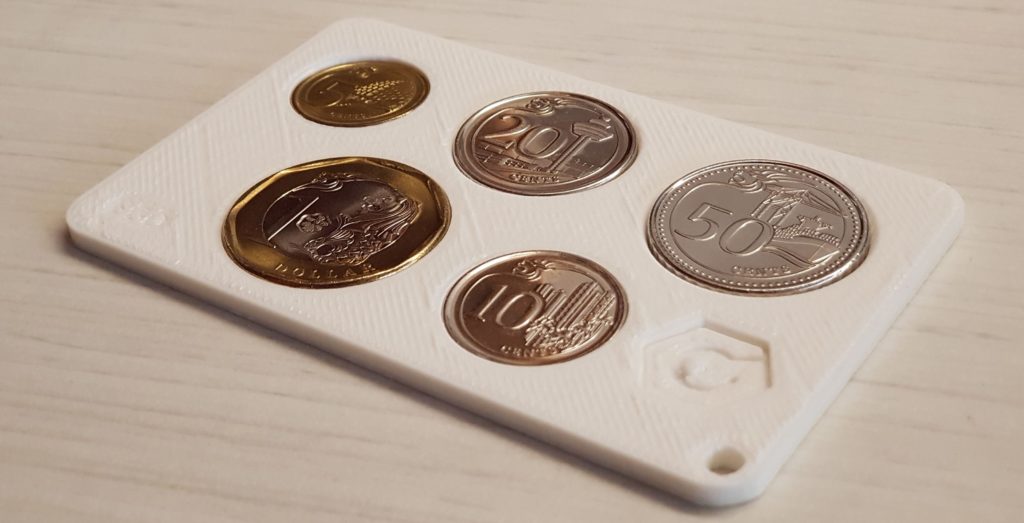
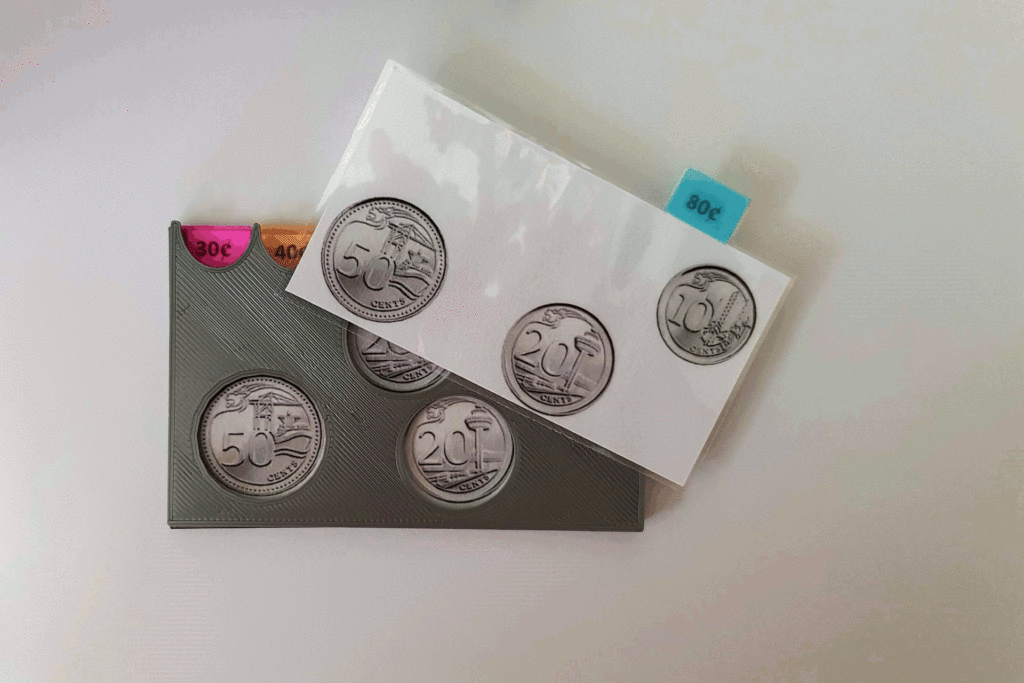
And then the community did what it always does: it kept going. The first version — five round pits for the five denominations, printed at Tech Able on a MakerBot Replicator — went to a CPH client to try. It helped with handling the coins, but counting them was still hard. So the next version added a slot for laminated cards: up to six of them, each one showing a combination of coins that adds up to a labelled amount, colour-coded, so you can match the coins through the pits instead of doing the sums in your head. Their example: 80 cents is one 50, one 20 and one 10. And the card kept evolving after that — tighter tolerances so the coins grip properly, smoother edges, labels added, and, most importantly, a different shape cut into each through-hole so you can tell the denominations apart by touch alone. Printed in PETG, the coins stay put even when the card is turned upside down. That last detail matters more than it sounds: a coin holder you cannot trust upside down is a coin holder you cannot trust in a pocket.
The sorter is the holder’s bigger sibling. Tip a handful of change into the top and gravity does the work — each coin slides down into its own column, sorted by size, stacked and ready to count. It is a remix of an existing open design, re-sized for Singapore coins and tested with real-world use, made for a Singapore occupational therapist’s use case. Same idea, different shape: the coins sort themselves, instead of you sorting them.
And there is a third one in the family, because of course there is. The coin puck — a round, pocket-sized holder — was co-created by Vincent with volunteer participants at a MakeIT Sunday session at Punggol Library Makerspace. Three versions of one idea, all printed in a range of colours at Sunday sessions, all iterated with the people who would actually carry them.
That is the fastest co-design loop in the whole collection, and it shows in the details. Nobody sat down and designed a coin system in the abstract. A person was frustrated at a checkout; volunteers printed something; the person tried it; the counting got its own answer in a set of laminated cards; then the tolerances tightened, the edges smoothed, and the holes got their tactile shapes. One Sunday’s prototype became the next version, and then the next one after that.
So — what does independence look like? Sometimes it looks like a card in a wallet, a puck in a pocket, or a sorter on a counter, with the right coin always the one your fingers find first. If you have ever fumbled for change at a till, you know exactly how big that small thing is.
Come to a Sunday session and try one. Bring your coins, bring your wallet, tell us what does not fit — and we will print the next version with you.
What a maker can do
- Start from the person’s pocket, not the printer. A wallet-sized card, a pocket puck, a counter-top sorter — three shapes for three different moments. Ask where the coins actually live before you print anything.
- Let touch do the telling. Different shapes for each through-hole mean the denominations can be told apart without looking. Labels help; shape is what works in a pocket.
- If the counting is the hard part, print the answer too. The laminated cards slot into the holder and show which coins add up to the amount — 80 cents is one 50, one 20 and one 10 — colour-coded, so you match the coins through the pits instead of doing the sums in your head at the till.
- Mind the tolerances — and the material. The v2 holder’s tighter fit and smoother edges are the whole improvement, and PETG holds the press-fit better than PLA: coins stay put when the card is inverted. Print a test fit before a full run.
- Remix openly, size locally. The sorter is a remix of an existing open design, re-sized from MAS Third Series dimensions. You do not need to invent a sorter — you need to make the existing one fit Singapore coins, then test it with real change.
- Iterate in the open, with the user. The holder’s v2 exists because v1 was tried by a real person. Print one, hand it over, watch what frustrates them, print again.
Sources
- Rapid prototype with participants — @salvagegardenmakerspace, 2 Dec 2023: https://www.instagram.com/p/C0YUcZ1ORUa/
- Coin sorter/holder — @salvagegardenmakerspace, 27 Jan 2024: https://www.instagram.com/p/C2oWmQ4SSrV/
- SGD Auto Coin Sorter — Printables model 695162: https://www.printables.com/model/695162-sgd-auto-coin-sorter
- SGD Coin Holder Card — Printables model 616818: https://www.printables.com/model/616818-sgd-coin-holder-card
- SGD Coin CANister EDC coin holder puck — Printables model 637515: https://www.printables.com/model/637515-sgd-coin-canister-edc-coin-holder-puck
- 3D-Printed Coin Card Holder — TechAble, 23 Dec 2020: https://techable.enablingvillage.sg/news/3d-printed-coin-card-holder
- Project: 3D Printed Coin Holder — SalvageGarden: https://salvage.garden/project-3d-printed-coin-holder/